AMEC Symposium on Economic Uncertainty: Exploring Heightened Volatility at the Federal Reserve Bank of New York
- Nov 13, 2025
- 4 min read
Key Themes: Deglobalization, Supply Chains, and Tariff-Driven Volatility
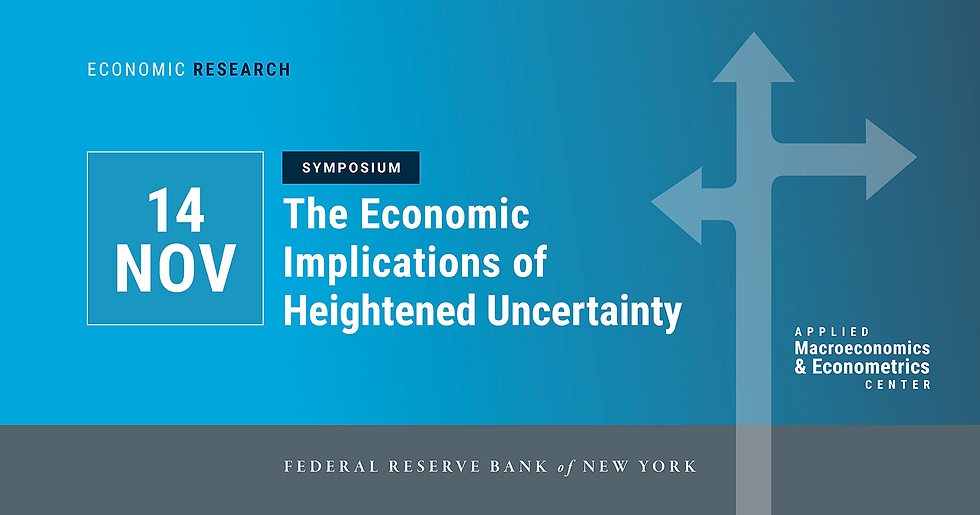
Central to the discussions is the surge in uncertainty, with the U.S. Economic Policy Uncertainty Index spiking to levels like 687.94 on November 10, 2025, and global indexes hitting all-time highs amid trade tensions. Session 1 on trade will probe deglobalization risks, supply chain resilience, and implications for U.S. productivity, directly tying into President Trump's tariff hikes. Tariffs of 10-60% on imports, particularly from China, are amplifying volatility in AI and hardware sectors by raising costs for semiconductors and components, potentially spiking AI server prices by up to 75% and disrupting global innovation. This could hinder U.S. competitiveness, delay tech deployments, and affect investment in emerging technologies.
Financial markets (Session 2) may explore how uncertainty erodes liquidity and amplifies policy shocks, while Sessions 3 and 4 delve into firm/household behaviors and macroeconomic responses, questioning whether uncertainty acts as a demand shock and how monetary policy should adapt. Overall, the symposium highlights uncertainty's drag on productivity and investment, with 2025's elevated indexes—driven by tariffs, geopolitics, and fiscal debates—potentially reshaping economic outlooks.

10:00 AM: Introduction by Marco Del Negro (FRBNY).
10:05 AM–11:05 AM: Session 1: Trade in an Uncertain World, chaired by Julian Di Giovanni (FRBNY). Panelists: Nuno Limão (Georgetown University), Steve Redding (Stanford University).
11:10 AM–12:10 PM: Session 2: Uncertainty and Financial Markets, chaired by Nina Boyarchenko (FRBNY). Panelists: Valentin Haddad (UCLA Anderson), Sydney Ludvigson (New York University).
12:10 PM–1:00 PM: Lunch break.
1:00 PM–2:00 PM: Session 3: The Effect of Uncertainty on Firms and Households, chaired by Jeremy Pearce (FRBNY). Panelists: Nick Bloom (Stanford University), Stefanie Stantcheva (Harvard University).
2:05 PM–3:05 PM: Session 4: Uncertainty and the Macroeconomy, chaired by Marco Del Negro (FRBNY). Panelists: Steve Davis (Hoover Institution and Stanford Institute for Economic Policy Research), Simon Gilchrist (New York University).
The event is hybrid, with most panelists in-person at the FRBNY in New York City and virtual attendance open to the public. Media can register for in-person or virtual access, and a recording will be available post-event.
Implications for Tech, Productivity, and Broader Economy
Tying into tech and tariffs, panels will likely address how policy uncertainty exacerbates supply chain vulnerabilities, especially for AI/hardware imports reliant on East Asian manufacturing. Trump's proposals, including 100% tariffs on semiconductors, threaten to undermine U.S. AI buildouts worth trillions, raising hardware costs and stalling innovation ecosystems. This could lead to slower U.S. productivity growth and reduced investment, with broader effects on allies like the UK through disrupted high-value tech collaborations. As a Fed-hosted forum, insights may influence narratives on resilience and policy responses in an era of historic uncertainty.
FRBNY: AMEC Symposium on The Economic Implications of Heightened Uncertainty - https://www.newyorkfed.org/research/conference/2025/Amec-symposium
FRBNY: New York Fed Hosts Symposium on the Economic Implications of Heightened Uncertainty - https://www.newyorkfed.org/newsevents/mediaadvisory/2025/1103-2025
LinkedIn: Federal Reserve Bank of New York's Post - https://www.linkedin.com/posts/federal-reserve-bank-of-new-york_amec-symposium-on-the-economic-implications-activity-7379951846305738752-cBoc
Bank Policy Institute: Research Exchange: October 2025 - https://bpi.com/research-exchange-october-2025/
X: New York Fed Research - https://x.com/NYFedResearch/status/1980370117637668947
FRBNY: Applied Macroeconomics & Econometrics Center (AMEC) - https://www.newyorkfed.org/research/amec
Facebook: Join us on Friday, November 14, for a hybrid symposium - https://www.facebook.com/newyorkfed/posts/join-us-on-friday-november-14-for-a-hybrid-symposium-on-the-economic-implication/1223942923103846/
Yennik: The E-mail Banking News - https://www.yennik.com/go/email_banking_news.htm
Minneapolis Fed: 2025 Institute Research Conference - https://www.minneapolisfed.org/events/2025/2025-institute-research-conference
X: New York Fed Research Profile - https://x.com/NYFedResearch
Policy Uncertainty: Economic Policy Uncertainty Index - https://www.policyuncertainty.com/
IMF: Even as Global Uncertainty Surges, Economic Sentiment Remains Positive - https://www.imf.org/en/blogs/articles/2025/11/10/even-as-global-uncertainty-surges-economic-sentiment-remains-positive
FRED: Economic Policy Uncertainty Index for United States (USEPUINDXD) - https://fred.stlouisfed.org/series/USEPUINDXD
Trading Economics: Economic Policy Uncertainty for United States - https://tradingeconomics.com/united-states/economic-policy-uncertainty-index-for-united-states-fed-data.html
World Economic Forum: Uncertainty is impacting the global economy. But how is it measured? - https://www.weforum.org/stories/2025/10/uncertainty-impacting-global-economy-how-is-it-measured/
UVA Darden: What's Driving Unprecedented Uncertainty in 2025 and How Can We Manage It? - https://news.darden.virginia.edu/2025/05/22/whats-driving-unprecedented-uncertainty-in-2025-and-how-can-we-manage-it/
Current Market Valuation: Economic Policy Uncertainty - https://www.currentmarketvaluation.com/models/economic-policy-uncertainty.php
McKinsey: Economic uncertainty hits new high - https://www.mckinsey.com/featured-insights/week-in-charts/economic-uncertainty-hits-new-high
Voronoi: Global Economic Policy Uncertainty Index Hits All-Time High in 2025 - https://www.voronoiapp.com/economy/-Global-Economic-Policy-Uncertainty-Index-Hits-All-Time-High-in-2025-683
Reddit: Global Economic Policy Uncertainty Index Hits All-Time High in 2025 - https://www.reddit.com/r/Infographics/comments/1j6k3wv/global_economic_policy_uncertainty_index_hits/
CSIS: How Tariffs Could Derail the United States' $3 Trillion AI Buildout - https://www.csis.org/analysis/how-tariffs-could-derail-united-states-3-trillion-ai-buildout
AI Magazine: How Trump Tariffs Impact the Future of Global AI Innovation - https://aimagazine.com/news/how-trump-tariffs-impact-the-future-of-global-ai-innovation
War on the Rocks: Hardware and Hard Truths: Trump's Tariffs Could Hurt American AI - https://warontherocks.com/2024/12/hardware-and-hard-truths-trumps-tariffs-could-hurt-american-ai/
MarketsandMarkets: Trump Tariff Impact on Edge AI Hardware Market - https://www.marketsandmarkets.com/ResearchInsight/trump-tariff-impact-edge-ai-hardware-market.asp
The Conversation: Trump's tariffs threaten the future of innovation – and UK tech could be collateral damage - https://theconversation.com/trumps-tariffs-threaten-the-future-of-innovation-and-uk-tech-could-be-collateral-damage-269158
Atlantic Council: Why tariffs on AI hardware could undermine US competitiveness - https://www.atlanticcouncil.org/blogs/new-atlanticist/why-tariffs-on-ai-hardware-could-undermine-us-competitiveness/
Z2Data: How Trump Administration Tariffs Are Impacting U.S. Imports - https://www.z2data.com/insights/how-trump-administration-tariffs-are-impacting-u-s-imports-a-z2data-analysis
Yahoo Finance: Trump's tariffs threaten the future of innovation – and UK tech could be collateral damage - https://uk.finance.yahoo.com/news/trump-tariffs-threaten-future-innovation-172810701.html
Sourceability: Trump's new chip export tariff deal with AI - https://sourceability.com/post/trump-chip-export-levy-reshapes-semiconductor-trade
[post:29] X Post by NYFedResearch: Join us for a hybrid #AMEC symposium - https://x.com/NYFedResearch/status/1985817195302060193
[post:30] X Post by NYFedResearch: Join us for a hybrid #AMEC symposium - https://x.com/NYFedResearch/status/1980370117637668947
[post:31] X Post by NYFedResearch: Join us for a hybrid #AMEC symposium - https://x.com/NYFedResearch/status/1976347005224910873
[post:32] X Post by NYFedResearch: Join us for a hybrid #AMEC symposium - https://x.com/NYFedResearch/status/1974129270503960610