Blue Origin's New Glenn Rocket: Anticipating the Second Launch
- Nov 8, 2025
- 6 min read

Research suggests the second launch of Blue Origin's New Glenn rocket is scheduled for November 9, 2025, marking a key milestone in reusable space technology. While success could enhance confidence in private space ventures, potential delays due to weather or technical issues remain a factor. The evidence points to positive outcomes from recent tests, though the high-stakes nature of space launches introduces uncertainty.
Key Highlights
Launch Details: The NG-2 mission is targeted for no earlier than 2:45 PM ET from Cape Canaveral Space Force Station, carrying NASA's ESCAPADE twin spacecraft to study Mars' atmosphere.
Technological Advancements: As a reusable heavy-lift rocket, New Glenn aims to reduce launch costs and compete with established players like SpaceX.
Market Implications: A successful flight may boost investor sentiment in aerospace and tech sectors, potentially influencing stocks tied to space innovation, such as Amazon through Jeff Bezos' involvement.
Risks and Opportunities: While reusable tech promises efficiency, any setbacks could highlight industry challenges amid growing investments in space and AI.
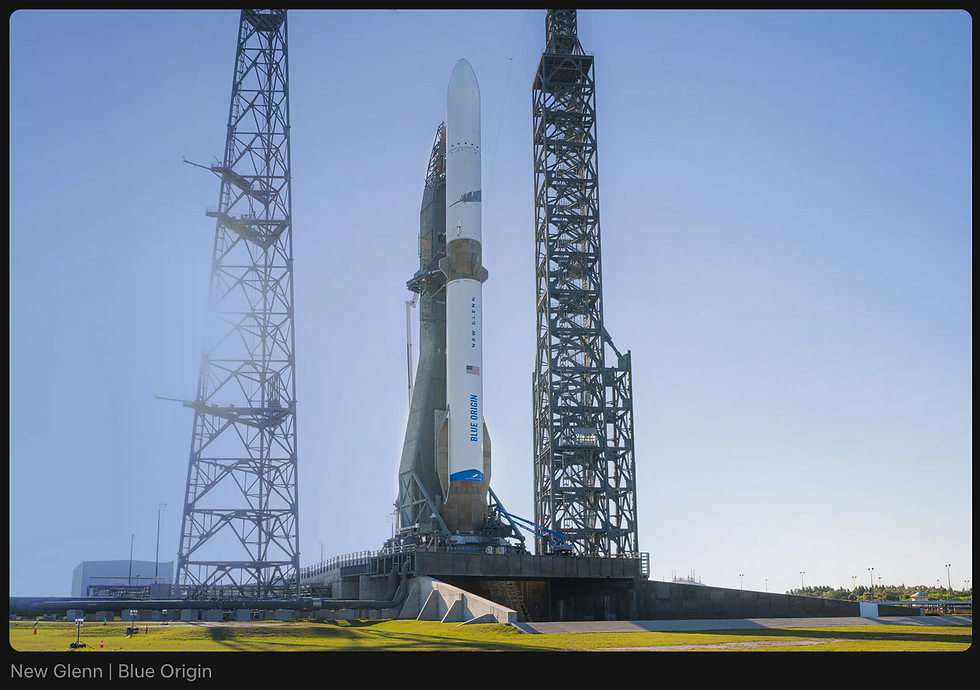
What is New Glenn? Blue Origin's New Glenn is a heavy-lift orbital rocket designed for reusability, standing over 320 feet tall and capable of delivering payloads to various orbits. It follows the successful inaugural flight in January 2025, which reached orbit and demonstrated core capabilities.
Why This Launch Matters This mission not only advances scientific exploration but also tests Blue Origin's ability to recover and reuse the first-stage booster, a critical step toward sustainable space travel. It underscores the competitive landscape in private spaceflight.
Potential Economic Ripple Effects With surging investments in space and related technologies, a strong performance could signal growth opportunities, though market reactions may vary based on outcomes. For more on the launch schedule, visit Spaceflight Now.

Blue Origin's New Glenn rocket is poised for its second launch on November 9, 2025, a event that could reshape the landscape of reusable rocket technology and private space exploration. As Jeff Bezos' space company pushes forward, this heavy-lift vehicle represents a direct competitor to SpaceX's offerings, highlighting advancements in aerospace engineering and their potential impact on global markets.
Founded by Amazon billionaire Jeff Bezos in 2000, Blue Origin has steadily evolved from suborbital tourism with New Shepard to orbital ambitions with New Glenn. Named after astronaut John Glenn, the rocket was first announced in 2016 and faced multiple delays before its maiden voyage. The inaugural NG-1 mission lifted off on January 16, 2025, at 2:03 AM EST from Launch Complex 36 at Cape Canaveral Space Force Station, successfully reaching orbit and deploying a pathfinder version of Blue Origin's Blue Ring spacecraft. This debut not only marked Blue Origin as the first new space company to achieve orbit on its initial attempt but also validated the rocket's design for future missions.
Technical Specifications and Features
New Glenn stands out for its impressive scale and capabilities. At over 320 feet (98 meters) tall with a 7-meter diameter payload fairing, it offers twice the volume of standard fairings, accommodating larger satellites and complex payloads. The rocket is powered by seven BE-4 engines on the first stage, each producing 550,000 pounds of thrust using liquefied natural gas (LNG) and liquid oxygen (LOX) – a cleaner, more efficient alternative to kerosene. The second stage employs two BE-3U engines, fueled by liquid hydrogen, enabling precise insertions into high-energy orbits.
Key reusability features include actuated aerodynamic fins, wing-like strakes for controlled descent, and six landing legs for touchdown on a downrange barge in the Atlantic Ocean. For the NG-2 mission, Blue Origin plans to attempt recovering the booster, building on lessons from NG-1 where recovery was not prioritized.
Feature | Blue Origin New Glenn (Reusable) | SpaceX Falcon Heavy (Reusable) |
Height | 320 ft (98 m) | 230 ft (70 m) |
Stages | 2 | 3 (with side boosters) |
First-Stage Engines | 7 x BE-4 (LNG/LOX) | 27 x Merlin (RP-1/LOX) |
Payload to LEO | 45 metric tons | ~30 metric tons (recoverable) |
Payload to GTO | 13 metric tons | ~8 metric tons (recoverable) |
Reusability Goal | 25+ flights per booster | 10+ flights per booster |
Launch Cost (Estimated) | ~$68 million | ~$90-150 million |
First Successful Launch | January 16, 2025 | February 6, 2018 |
The NG-2 Mission: ESCAPADE and Beyond
The second launch, NG-2, is set for no earlier than November 9, 2025, with a window opening at 2:45 PM ET (19:45 UTC). The primary payload is NASA's ESCAPADE (Escape and Plasma Acceleration and Dynamics Explorers) mission, consisting of two identical spacecraft built by Rocket Lab to study Mars' plasma environment and its interaction with solar wind. These probes will orbit Mars to gather data on atmospheric escape processes, aiding our understanding of the planet's evolution from a potentially habitable world to its current state.
In addition to ESCAPADE, the mission includes a Viasat technology demonstration that showcases New Glenn's versatility for multi-payload flights. Recent preparations have been promising: The rocket completed a static fire test, and despite minor transport damage to the second stage earlier, timelines remain on track. Backup dates include November 10-11 if needed, subject to weather and technical readiness.

The NG-2 Mission: ESCAPADE and Beyond
The second launch, NG-2, is set for no earlier than November 9, 2025, with a window opening at 2:45 PM ET (19:45 UTC). The primary payload is NASA's ESCAPADE (Escape and Plasma Acceleration and Dynamics Explorers) mission, consisting of two identical spacecraft built by Rocket Lab to study Mars' plasma environment and its interaction with solar wind. These probes will orbit Mars to gather data on atmospheric escape processes, aiding our understanding of the planet's evolution from a potentially habitable world to its current state.

In addition to ESCAPADE, the mission includes a Viasat technology demonstration that showcases New Glenn's versatility for multi-payload flights. Recent preparations have been promising: The rocket completed a static fire test, and despite minor transport damage to the second stage earlier, timelines remain on track. Backup dates include November 10-11 if needed, subject to weather and technical readiness.
Competition with SpaceX and Broader Industry Dynamics
New Glenn enters a market dominated by SpaceX, which has launched the Falcon Heavy on numerous high-profile missions, including satellite deployments and NASA contracts. While Falcon Heavy offers expendable modes for heavier lifts, New Glenn's single-configuration design simplifies operations and reduces costs for reusable flights. Experts note that New Glenn's larger fairing and hydrogen upper stage provide advantages for certain orbits, such as geostationary and beyond.
The rivalry extends to development timelines: SpaceX achieved reusable orbital landings in 2015, while Blue Origin's efforts have taken longer, partly due to challenges with engine development. However, with New Glenn now operational, Blue Origin could capture market share in commercial, civil, and defense sectors. Emerging competitors like China's Zhuque-3 are adding global pressure, underscoring the need for U.S. innovation.
Market-Moving Potential and Investment Surge
A successful NG-2 launch could bolster investor confidence in private space ventures, potentially driving up stock prices for aerospace and tech firms. Although Blue Origin remains private, its ties to Jeff Bezos may indirectly influence Amazon (AMZN) shares, primarily through Project Kuiper's $10 billion+ commitments. Broader ripple effects could affect space-related stocks, such as those in satellite manufacturing or launch services.
This comes amid a surge in AI and space investments, with global AI funding reaching $252 billion in 2024 and projections for continued growth. The AI in space exploration market alone is expected to expand from $6.7 billion in 2025 to $57.9 billion by 2034, fueled by applications in autonomous navigation and data analysis. However, a delay or failure – common in spaceflight – might trigger sell-offs, underscoring the sector's volatility.
Looking Ahead: Challenges and Opportunities
While New Glenn's progress is encouraging, challenges persist, including scaling production and achieving consistent reusability. Success on November 9 would not only advance NASA's Mars science but also solidify Blue Origin's position in the $400 billion+ space economy. As investments in AI-integrated space tech accelerate, this launch could catalyze further innovation, benefiting everything from broadband access to planetary exploration.
Blue Origin becomes first new space company to reach orbit on its first launch
Blue Origin's New Glenn rocket launch may occur Sunday in Florida
New Glenn Flight 2 is scheduled for November 9th at 2:45 PM EST ...
My preview of the key mission due to launch in November 2025 🚀
A look at New Glenn: Blue Origin's heavy-lift booster rocket
New Glenn's Launch Is an Even Bigger Deal for Amazon Than for ...
Jeff Bezos Just Launched a Massive Rocket. These Space Stocks ...
Blue Origin’s New Glenn is readying for its second launch as company ramps up challenge to SpaceX.
Ai In Space Exploration Market Outlook 2025-2034 - Yahoo Finance
There's some chatter out there about damage to Blue Origin's New Glenn rocket.
Last night Blue Origin successfully completed a static fire of their second New Glenn rocket!
Blue Origin's New Glenn: A New Player in the Orbital Launch Market
With New Glenn in Its Pocket, Can Blue Origin Compete ... - Nasdaq
🇺🇸🇨🇳 ELON HEADED TO 98% ORBITAL MARKET SHARE - BEZOS STILL HASN'T LAUNCHED YET
Why doesn't Blue invest more in defense industry : r/BlueOrigin