COP30 Health Day: Spotlight on Climate-Resilient Health Systems Amid Global Challenges
- Nov 12, 2025
- 4 min read

Day 4 of the COP30 United Nations Climate Change Conference in Belém, Brazil, marks "Health Day," a pivotal focus on the intersection of climate change and public health. Hosted from November 10 to 21, 2025, in the heart of the Amazon region, the summit brings together world leaders, experts, and advocates to address escalating climate threats. The day's centerpiece is the Ministerial Health Plenary, scheduled from 9:00 AM to 11:00 AM local time, emphasizing the need for resilient health systems in the face of climate-induced crises. Co-hosted by the World Health Organization (WHO) and the United Nations Framework Convention on Climate Change (UNFCCC), discussions aim to link environmental changes to health emergencies, such as increased disease outbreaks, heat-related illnesses, and food insecurity.
This theme resonates globally, as climate change exacerbates vulnerabilities in health infrastructure, particularly in low-income nations. Potential outcomes include pledges to enhance funding for adaptation efforts in vulnerable countries, aligning with COP30's Objective 16 on promoting resilient health services. Parallel to the main summit, events such as the World Climate Summit are amplifying these calls, fostering cross-sector collaborations to develop actionable climate-health strategies.

Linking Climate Impacts to Health Crises
The plenary sessions delve into how rising temperatures, extreme weather events, and biodiversity loss fuel health risks. For instance, warmer climates expand the range of vector-borne diseases like malaria and dengue, straining healthcare systems already burdened by pandemics. WHO Director-General Tedros Adhanom Ghebreyesus has emphasized that "the climate crisis is a health crisis," advocating for health to be integrated into future COP negotiations. Experts at COP30, including those from the Centre for Epidemic Response & Innovation, are calling for strengthened surveillance, genomic tracking, and sustainable funding to build climate-resilient health systems.
Youth delegates from groups like YOUNGO Health are also vocal, pushing for climate-health justice and highlighting the disproportionate impacts on younger generations. Discussions extend to emerging threats, such as the health effects of micro- and nanoplastics, which accumulate electrostatic charges and contribute to chronic diseases and ecosystem degradation. Philanthropic funding for climate adaptation has surged to $870 million in 2024, but experts warn it's insufficient without urgent, evidence-based action.

Global Scrutiny: Trump's Tariff Policies and Their Ripple Effects
Amid these talks, President Donald Trump's tariff policies are under intense scrutiny for potentially undermining global climate goals. Proposed tariffs on imports, particularly from China, could inflate costs for green technologies like solar panels, batteries, and other clean energy components. China dominates the solar panel market, producing over 80% of the world's supply at competitive prices due to economies of scale, advanced manufacturing, and government subsidies. These low-cost imports have accelerated renewable energy adoption worldwide, but tariffs—potentially as high as 3500% on certain solar products—aim to protect U.S. domestic manufacturing by making foreign goods more expensive.
For the United States, this could slow the energy transition. Higher import costs may reduce solar deployments, increasing reliance on fossil fuels and hindering emission reduction targets under agreements like the Paris Accord. Experts estimate that tariffs could raise clean energy project expenses by 10-25%, impacting jobs in installation and maintenance while benefiting a smaller domestic production sector. This contradicts U.S. climate ambitions, potentially adding billions to energy costs and delaying net-zero goals.
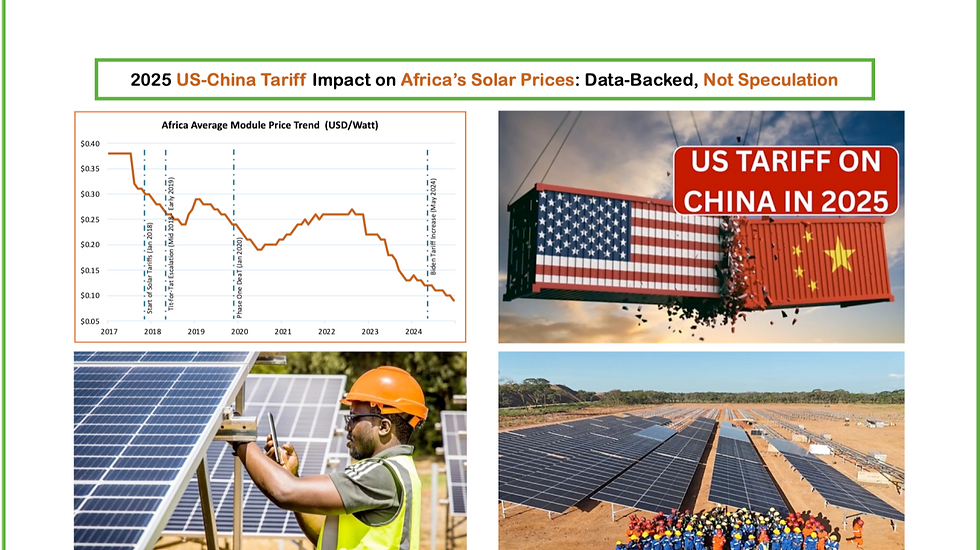
The implications extend to NATO allies, where tariffs disrupt transatlantic trade and shared climate security efforts. European NATO members, heavily reliant on Chinese green tech imports for their own renewable transitions, face higher costs that could strain economies already investing in defense spending. Trump's threats of tariffs on allies like Spain for insufficient NATO contributions exacerbate tensions, weakening collective action on climate as a security threat—such as migration, resource conflicts, and disaster response. NATO has increasingly viewed climate change as a "threat multiplier," and U.S. policies that hinder global decarbonization could erode alliance cohesion, forcing allies to diversify supply chains or retaliate with their own trade measures.

Amplifying Voices: X Conversations and Parallel Events
On X (formerly Twitter), conversations are buzzing with calls for action. Posts from organizations like Power Shift Africa demand tangible adaptation finance, criticizing wealthy nations for delays and disinformation. Youth advocates and researchers are sharing insights on the links between climate and health, urging integrity in information to combat denialism. The PAHO/WHO delegation highlighted digital health initiatives for resilience during panels at parallel events.
WHO: COP30 Health Day - https://www.who.int/news-room/events/detail/2025/11/13/default-calendar/cop30-health-day
UNFCCC: UN Climate Change Conference - Belém, November 2025 - https://unfccc.int/cop30
WHO: COP30 Health Pavilion - https://www.who.int/news-room/events/detail/2025/11/10/default-calendar/cop30-health-pavilion
Climate and Health Alliance: COP30: Climate and Health at the UN Climate Change Conference - https://climateandhealthalliance.org/cop30/
DNDi: COP30 - https://dndi.org/events/2025/cop30/
TIME: The Biggest Clean Energy Impacts from Trump's Tariffs - https://time.com/7275714/trump-tariffs-biggest-clean-energy-impacts/
Columbia Energy Policy: Q&A | Solar Tariffs and the US Energy Transition - https://www.energypolicy.columbia.edu/qa-solar-tariffs-and-the-us-energy-transition/
Carnegie Endowment: How the U.S.-China Trade War Could Derail the Energy Transition - https://carnegieendowment.org/emissary/2025/04/us-china-trade-war-tariffs-critical-minerals-clean-energy-impacts?lang=en
New York Times: Can 3500 Percent Tariffs Protect the U.S. Solar Industry? - https://www.nytimes.com/2025/04/24/climate/solar-tariffs-united-states-china.html
American Action Forum: The Impact of Tariffs on Utility-Scale Solar - https://www.americanactionforum.org/research/the-impact-of-tariffs-on-utility-scale-solar/
Canary Media: Trump's tariffs undermine his energy and manufacturing goals - https://www.canarymedia.com/articles/policy-regulation/trump-tariffs-clean-energy-industry
CFR: Geopolitics of Trump Tariffs: How U.S. Trade Policy Has Shaken Allies - https://www.cfr.org/article/geopolitics-trump-tariffs-how-us-trade-policy-has-shaken-allies
The Conversation: How Trump's trade policies are weakening international climate commitments - https://theconversation.com/how-trumps-trade-policies-are-weakening-international-climate-commitments-269409
PIIE: Imposing tariffs on US allies undermines national security - https://www.piie.com/blogs/realtime-economics/2025/imposing-tariffs-us-allies-undermines-national-security
CSIS: The Transatlantic Alliance in the Age of Trump: The Coming Collisions - https://www.csis.org/analysis/transatlantic-alliance-age-trump-coming-collisions
Reuters: Trump threatens tariffs on Spain over refusal to boost NATO defense spending - https://www.reuters.com/world/europe/trump-threatens-tariffs-spain-over-refusal-boost-nato-defense-spending-2025-10-14/
[post:18] X Post by CERI: Climate change and infectious diseases report - https://x.com/ceri_news/status/1988690372390977987
[post:19] X Post by Jasmine: ALLATRA presentation on microplastics - https://x.com/Jasmine42368794/status/1988663237576171924
[post:20] X Post by YOUNGO Health: Youth delegates at COP30 - https://x.com/YoungoHealth/status/1988663186334314872
[post:21] X Post by That Smoke Pit Veteran: WHO on climate as health crisis - https://x.com/thatsmokepit/status/1988662286253216069
[post:22] X Post by Africa Solutions Media Hub: Philanthropic funding for adaptation - https://x.com/africsolutions/status/1988661890894139805
[post:23] X Post by chris j.a. coutinho: Information integrity at COP30 - https://x.com/a1chrisjc/status/1988660127663288717
[post:25] X Post by Franci Grojzdek: Presentation on nanoplastics impact - https://x.com/FG65284/status/1988659258930377179
[post:26] X Post by Mr. Climate: Need for proof in pledges - https://x.com/OlumideIDOWU/status/1988657319845236856
[post:27] X Post by Sudipta: COP30 and Climate-Health Nexus blog - https://x.com/Sudipta070509/status/1988646266973360482
[post:28] X Post by PAHO/WHO: Delegation at COP30 panel - https://x.com/pahowho/status/1988645911069917421