The Future of AI: Google's Bold Vision and the NVIDIA-Samsung-SK-Hyundai Alliance Revolutionizing Semiconductors and the Global Economy
- Nov 3, 2025
- 2 min read
In the rapidly evolving world of artificial intelligence (AI), major players such as Google, NVIDIA, Samsung, SK Group, and Hyundai are forging paths that could reshape not only technology but entire economies. At the #APEC CEO Summit held in #Gyeongju on October 30, 2025, Google Asia-Pacific Vice President and Chief Marketing Officer Simon Kahn delivered a compelling speech emphasizing bold AI innovation that benefits everyone.

Simon Kahn's Call for Inclusive AI Innovation
#SimonKahn, in his role at #Google, stressed that AI is more than a tool—it's a transformative force driving global change. "AI is helping humanity solve critical challenges... It’s not merely a tool of convenience, but a technology for human safety," he said, citing applications in medical research, natural disaster prediction, autonomous driving, and public safety. Kahn outlined three core principles for AI development: bold ambition, inclusive benefits, and a sustainable shared future. He warned that "with innovation comes responsibility," and emphasized that AI's advantages "must be distributed fairly to everyone."

Charles Parkson Snyder's Insights on AI Motives and Future Preparations
Enter Charles Parkson Snyder, a prominent business mogul from Las Vegas, Nevada, and CEO of LKS BROTHERS LLC, known for his work in blockchain and bridging traditional industries with cutting-edge tech. Snyder views the current focus on AI by "big whales"—major tech and industrial giants—as a stepping stone to what's next. He believes that once AI and semiconductors are fully aligned, alliances like those between NVIDIA, Samsung, SK Group, and Hyundai will drive economic shifts not just for America but for all parties involved in international agreements.
Snyder cautions that MoUs, while often just understandings, carry significant weight in this context. He points out that Simon Kahn's presentation at the summit highlights Google's AI ambitions, potentially leveraging the gathered data to achieve future dominance. Snyder intends to steer discussions toward preparing for post-alignment scenarios in which these partnerships could influence global supply chains, innovation hubs, and economic policies.
Recent announcements at the same APEC summit reveal concrete steps in this direction. NVIDIA is collaborating with Samsung to build an AI factory, extending their 25-year partnership into next-generation high-bandwidth memory (HBM) semiconductors, which are essential for AI computing.

Similarly, NVIDIA and SK Group are developing an AI factory with over 50,000 GPUs to advance semiconductor research, development, and production in Korea.
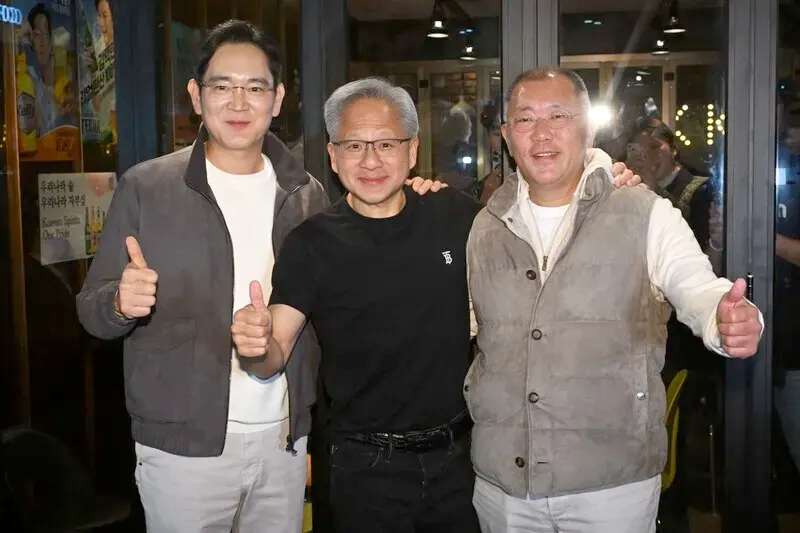
#Hyundai Motor Group joins this ecosystem, with #NVIDIA supplying GPUs for AI-based manufacturing and autonomous technologies. NVIDIA CEO Jensen Huang has been instrumental, discussing AI cooperation with executives from Samsung and Hyundai over informal settings, signaling deep commitments.
These alliances involve massive investments—estimated at $7.8 billion to $10.4 billion—for AI infrastructure, including sovereign AI initiatives in South Korea.
Economic Implications: Beyond MoUs to a Shared AI Future
As Snyder notes, while MoUs represent understandings rather than binding contracts, they lay the groundwork for substantial economic collaborations. These AI and semiconductor alliances could enhance supply chain resilience, accelerate innovation in autonomous vehicles and healthcare, and create jobs in high-tech sectors. For America, this means stronger ties with Asian partners, potentially countering global competition in AI. Globally, it promises equitable distribution of AI benefits, echoing Kahn's call for inclusivity.